



Toughest Topics in GATE Mechanical, CS, and ECE- And How to Master Them
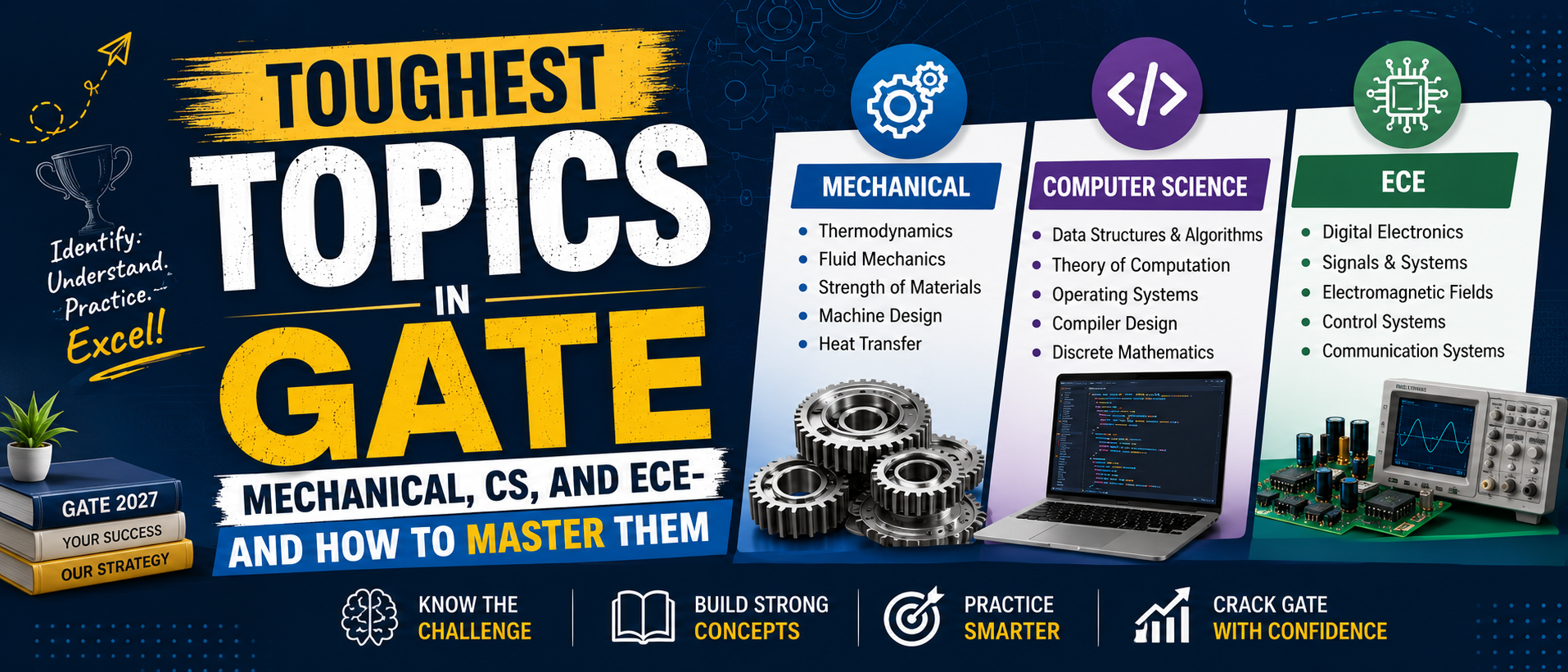
Every GATE aspirant hits a wall at some point. It's usually not the "easy" subjects that trip candidates up — it's a handful of notoriously dense, conceptually loaded topics that show up year after year, carry heavy weightage, and quietly decide your final rank. Knowing which topics these are — and having an actual plan to tackle them — can save you months of directionless studying.
This post breaks down the toughest topics in Mechanical, CS, and ECE, and gives you a practical approach to master each one.
Why Some Topics Feel "Tougher" Than Others
Before getting into specifics, it helps to understand why certain topics are harder:
They combine multiple concepts. Topics like Heat Transfer or Control Systems aren't isolated — they pull in calculus, prior subject knowledge, and physical intuition all at once.
They're abstract with few "shortcuts." Unlike numerical-heavy topics where practice alone gets you far, some topics (Theory of Computation, for instance) require genuine conceptual clarity — you can't pattern-match your way through them.
They have a steep visualization requirement. Subjects like Fluid Mechanics or Electromagnetics demand that you "see" what's happening physically, not just plug into formulas.
They're rarely taught well in undergrad. Many core engineering topics are rushed through in college, leaving gaps that only surface during GATE prep.
With that context, here's the breakdown by branch.
MECHANICAL ENGINEERING (GATE ME)
1. Heat Transfer
Heat Transfer is where students often lose easy marks — not because the concepts are impossible, but because the three sub-areas (conduction, convection, radiation) each have their own set of formulas, boundary conditions, and dimensionless numbers (Nusselt, Prandtl, Grashof, Biot) that are easy to mix up under exam pressure.
How to master it: Build a single consolidated formula sheet organizing all dimensionless numbers by what they represent (not just their formulas) — this connects the physics to the math. Solve fin problems and transient conduction (lumped heat capacity) problems separately as focused practice sets, since these appear almost every year.
2. Fluid Mechanics
The difficulty here comes from constantly switching between physical intuition and mathematical derivation — Bernoulli's equation looks simple until it's combined with boundary layer theory or compressible flow.
How to master it: Master the control volume approach first; almost every fluid mechanics problem in GATE can be traced back to conservation of mass, momentum, or energy applied to a control volume. Don't memorize derivations — understand the assumptions behind each equation, because GATE loves testing "which assumption breaks here."
3. Theory of Machines / Machine Design
This is less about difficulty and more about the sheer number of formulas and diagrams (gear trains, cams, balancing of masses) that need to be visualized correctly.
How to master it: Use diagram-first learning — redraw every mechanism from memory before attempting numericals. Balancing and gear train problems reward pattern recognition, so previous year papers are your best resource here.
Want to put these Mechanical topics into practice? Work through actual exam-level questions with the GATE Mechanical Engineering Previous Year Solved Papers.
COMPUTER SCIENCE (GATE CS)
1. Theory of Computation (TOC)
TOC is consistently ranked the toughest CS topic because it's purely conceptual — automata, grammars, decidability, and reducibility don't have "plug and chug" formulas. You either understand the logic or you don't.
How to master it: Build TOC bottom-up: master DFA/NFA construction by hand before moving to CFGs, and only then tackle decidability/undecidability. Don't skip constructing automata for simple languages yourself — this is where real understanding is built, not from watching solutions.
2. Computer Networks
The challenge in CN isn't any single topic but the breadth — from physical layer concepts to routing algorithms to congestion control — all loosely connected, with numerical and conceptual questions mixed together.
How to master it: Divide CN into "numerical-heavy" areas (subnetting, sliding window, Bellman-Ford/Dijkstra) and "conceptual-heavy" areas (protocols, layers), and prepare them with different strategies — spaced repetition for concepts, timed problem sets for numericals.
3. Compiler Design / Operating Systems (Deadlocks, Concurrency)
These topics test the ability to trace through processes step-by-step — a single mistake in tracking state (like a semaphore value or a stack during parsing) cascades into a wrong answer.
How to master it: Practice with pen and paper, tracing every step explicitly rather than trying to do it in your head. For deadlocks and concurrency, work through Banker's Algorithm and producer-consumer problems until the state-tracking becomes automatic.
Want to test your grip on these CS topics? Practice with the GATE Computer Science and IT Previous Year Solved Papers.
ELECTRONICS & COMMUNICATION (GATE ECE)
1. Electromagnetics
Widely considered the hardest ECE topic — it demands strong vector calculus skills alongside physical intuition about fields, and there's very little room for guesswork.
How to master it: Strengthen vector calculus (divergence, curl, gradient) as a standalone prerequisite before diving into Maxwell's equations. Focus disproportionately on transmission lines and waveguides, since these are more numerically tractable and appear reliably in the exam.
2. Control Systems
Control Systems is tough because it requires fluidly moving between time-domain and frequency-domain thinking — root locus, Bode plots, and Nyquist criteria all describe the same system differently, and GATE tests your ability to connect them.
How to master it: Instead of learning each technique (root locus, Bode, Nyquist) in isolation, solve the same system using all three methods side by side. This builds the cross-domain intuition that GATE questions are designed to test.
3. Analog and Digital Communication
The difficulty here is conceptual density packed into a small number of marks — modulation schemes, noise analysis, and information theory all have subtly different formulas that are easy to confuse.
How to master it: Create comparison tables for modulation techniques (AM vs FM vs PM, and their digital counterparts) side by side with their bandwidth, power, and noise performance — GATE frequently tests these as direct comparisons.
Ready to test yourself on these ECE topics? Practice with the GATE Electronics Engineering Previous Year Solved Papers.
A GENERAL STRATEGY THAT WORKS ACROSS ALL BRANCHES
Regardless of branch, the toughest topics respond well to the same core approach:
1. Isolate the topic and go deep before going wide. Don't try to "cover" a hard topic in one pass — dedicate a focused block of days to it alone.
2. Prioritize concept clarity over formula memorization. GATE increasingly tests application and reasoning, not rote recall.
3. Solve previous 10–15 years of questions topic-wise, not year-wise, so you see every variation the exam has thrown at that topic.
4. Track your error patterns. If you keep missing questions in the same sub-area, that's your signal to go back to fundamentals, not attempt more random problems.
5. Teach it to someone (or explain it out loud). If you can't explain a topic simply, you don't understand it well enough yet — this is especially true for TOC, Electromagnetics, and Control Systems.
Tough topics feel that way because they demand a different kind of preparation — one built on understanding rather than repetition. Once you shift your approach for these specific areas, they stop being weaknesses and start becoming reliable, high-scoring sections on exam day.