



RRB JE vs SSC JE: Which Is the Better Career Choice?
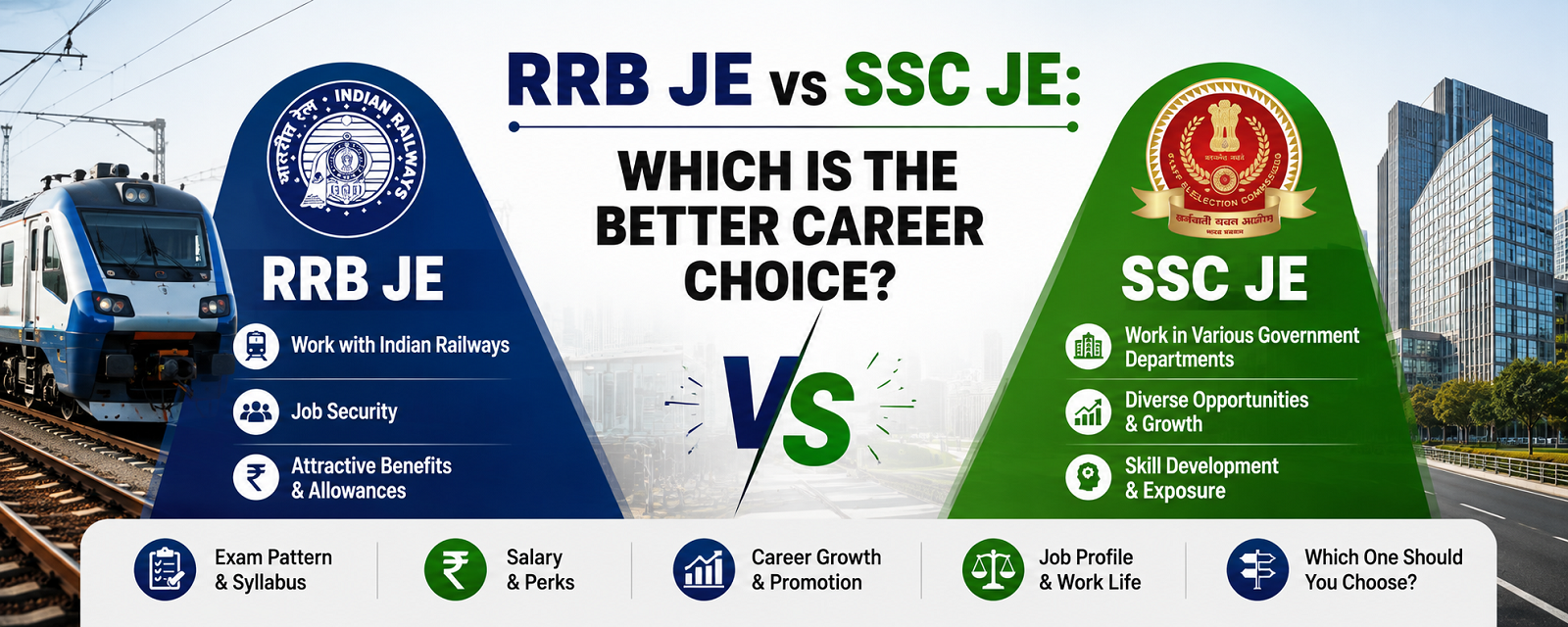
If you're an engineering diploma or degree holder eyeing a government job, you've almost certainly landed on these two names: RRB JE (Railway Recruitment Board — Junior Engineer) and SSC JE (Staff Selection Commission — Junior Engineer). Both lead to a stable, pensionable, Group B technical government job. Both pay roughly the same on paper. And both draw lakhs of applicants every cycle.
So which one should you actually prepare for? Let's break it down — pattern, pay, postings, and what day-to-day life looks like after you clear either one.
The Basics: Who Recruits, and For What
RRB JE recruits Junior Engineers (along with Depot Material Superintendents and Chemical & Metallurgical Assistants) directly into Indian Railways. Every zone, every division, one employer.
SSC JE recruits Junior Engineers for a spread of central government departments and organizations — think CPWD, MES (Military Engineer Services), BRO (Border Roads Organisation), and a few others depending on the year's notification. Your posting, and therefore your work environment, can vary a lot depending on which department you land in.
That single difference — one employer vs. several — shapes almost everything else about the comparison.
Exam Pattern: A Side-by-Side Look
RRB JE runs a two-stage CBT process:
- CBT-1: 100 questions, 90 minutes — Mathematics, General Intelligence & Reasoning, General Awareness, and General Science. Common to all engineering streams and mainly filters for aptitude.
- CBT-2: 120 questions, 90 minutes — General Awareness, Physics & Chemistry, Computer Applications, Environment & Pollution Control, and a heavy Technical section (100 of the 150 marks come from your core engineering subjects). This is where the exam is actually won or lost.
- Both stages carry 1/3rd negative marking.
- After CBT-2 comes Document Verification and a Medical Exam — no interview.
SSC JE also runs two papers, but they're structured differently:
- Paper 1: 200 questions, objective, computer-based — General Intelligence & Reasoning (50 marks), General Awareness (50 marks), and General Engineering in your discipline (100 marks). Negative marking is a lighter 0.25 per wrong answer.
- Paper 2: A heavier, discipline-specific technical paper worth 300 marks, now objective (it was descriptive before 2023). Negative marking here is a full 1 mark per wrong answer, so guesswork is riskier.
- Selection is based on combined Paper 1 + Paper 2 performance, followed by Document Verification. No PET/PST, no interview.
Takeaway: SSC JE's technical paper carries more weight (300 marks) and stricter negative marking, which rewards genuinely strong subject knowledge over guesswork. RRB JE's technical section is also decisive but sits inside a shorter, faster-paced CBT.
Pay and Perks
Here's the interesting part: both posts sit in Pay Level 6 (₹35,400—₹1,12,400) of the 7th CPC matrix. On the pay slip, they're nearly identical.
Where they diverge is in the extras:
- RRB JE employees get Railway-specific perks — free/concessional travel passes for self and family, railway quarters (where available), and a broader internal promotion ladder within the Railways' own cadre structure.
- SSC JE employees get standard central government allowances (DA, HRA, TA), and perks vary by the specific department you're posted to (CPWD housing benefits differ from MES or BRO benefits, for instance).
In-hand salary for freshers in both cases typically lands in the ₹44,000—₹52,000/month range depending on city classification (X/Y/Z) and department, before any field/hardship allowances.
Work Life: What You Actually Do
This is often the most underrated factor.
- RRB JE postings are almost entirely field-based — tracks, signaling, electrical traction, workshops, bridges, rolling stock. If you enjoy hands-on site work, shift schedules, and being close to operations, this suits you. Postings can be transfer-heavy across a zone.
- SSC JE work depends heavily on the department. CPWD JEs often manage government building projects (offices, hospitals, residential complexes) — more construction/maintenance-supervision flavored. MES and BRO postings can involve defense infrastructure and border-area road/bridge projects, which come with remote postings but also unique allowances and faster growth in some cases.
If you want variety and the possibility of a defense/infrastructure-adjacent career, SSC JE's spread of departments gives you that lottery. If you want one large, predictable organizational ecosystem with a well-worn promotion path, RRB JE is more linear.
Vacancies and Competition
RRB JE tends to release larger vacancy numbers in a single centralized notification (CEN) covering all railway zones at once, which historically means bigger cohorts and, for many disciplines, comparatively better odds per seat — though this swings a lot cycle to cycle based on how many posts are notified.
SSC JE vacancies are usually smaller in aggregate but spread across multiple departments, so your effective competition depends on which department/discipline combination you're strongest in.
Neither is “easy” — cut-offs for both have historically required serious, sustained technical preparation, not just last-month cramming.
Growth and Stability
- RRB JE → Senior Section Engineer (SSE) → further promotions within Railways is a well-documented, seniority-linked path.
- SSC JE → Assistant Engineer (AE)/higher grades, but the pace and route depend on the department; CPWD, MES, and BRO each have their own promotion cadres and timelines.
Both are central government jobs with pension benefits under NPS, job security, and DA revisions twice a year — this part is a wash.
So, Which Should You Choose?
There's no universal right answer, but here's a reasonable way to decide:
- Pick RRB JE if: you want one large, stable organization, don't mind field/shift-based railway work, and prefer a shorter, faster-paced two-stage CBT.
- Pick SSC JE if: you're drawn to construction/infrastructure supervision, want a shot at defense-adjacent postings (MES/BRO), and are comfortable with a technical paper that rewards deep subject mastery over speed.
- Best strategy for most aspirants: prepare for both. The core technical syllabus (Civil/Mechanical/Electrical fundamentals) overlaps heavily between the two exams, and general awareness/reasoning prep transfers almost completely. Treat them as two shots at the same underlying preparation rather than an either-or decision.