




How to Solve ESE Previous Year Questions for Maximum Benefit
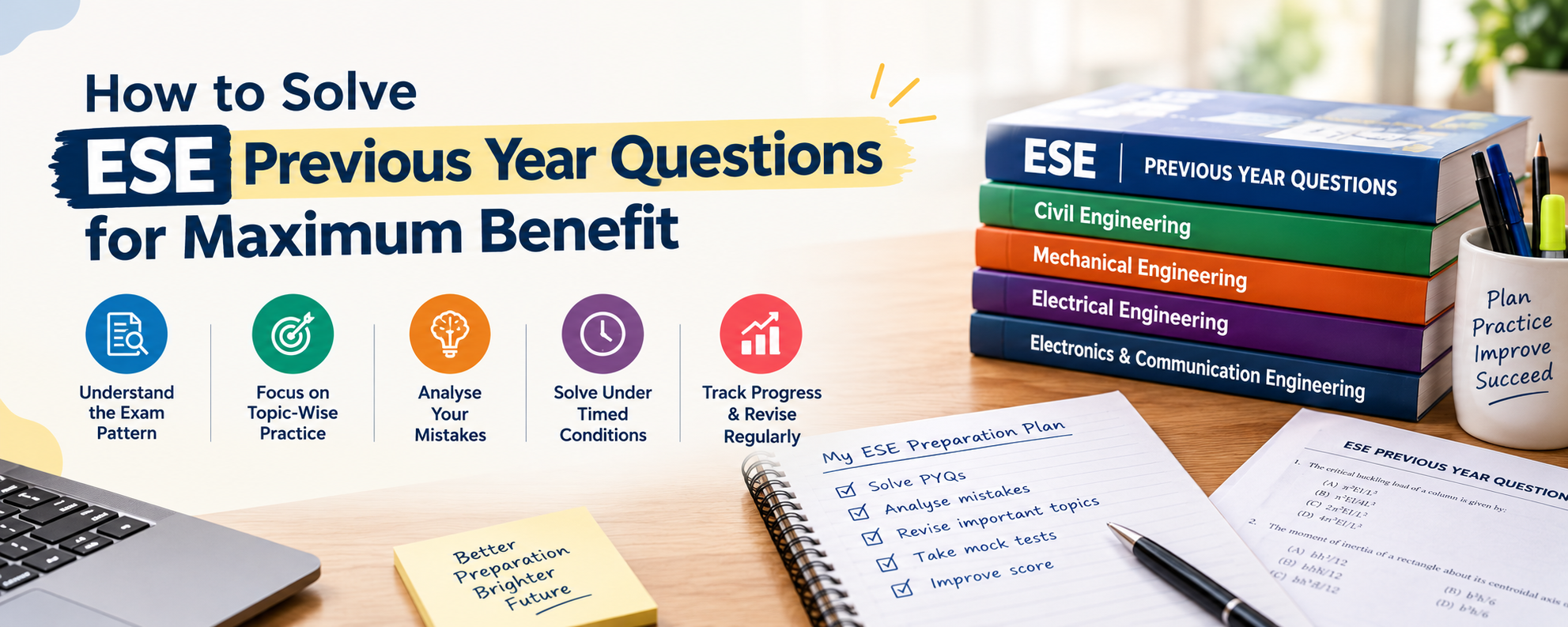
Preparing for the Engineering Services Examination (ESE) requires a strong understanding of core engineering concepts, consistent practice, and an effective revision strategy. While studying theory is essential, solving ESE Previous Year Questions (PYQs) is equally important for understanding the examination pattern, identifying important topics, and improving problem-solving skills.
However, simply solving questions is not enough. To get the maximum benefit from ESE previous year question papers, aspirants must approach them strategically, analyse their mistakes, and use the insights gained to improve their preparation.
In this blog, we will explore how to solve ESE PYQs effectively and make them an integral part of your preparation strategy.
1. Understand the ESE Exam Pattern Before Solving PYQs
Before starting with previous year questions, familiarise yourself with the ESE examination structure. The Engineering Services Examination conducted by the Union Public Service Commission (UPSC) includes Prelims and Mains, followed by the Personality Test for shortlisted candidates.
The Preliminary Examination includes General Studies and Engineering Aptitude, along with discipline-specific engineering questions. The Mains Examination focuses on conventional engineering questions that assess conceptual understanding and the ability to solve detailed problems.
Understanding the exam pattern helps you practise questions according to the requirements of each stage. It also allows you to identify the types of questions that require quick calculations, conceptual clarity, or detailed step-by-step solutions.
2. Start with Topic-Wise Previous Year Questions
One of the most effective ways to begin solving ESE PYQs is to practise them topic by topic rather than attempting complete papers immediately.
For example, if you are preparing for ESE Mechanical Engineering, you can begin with Engineering Mechanics, Thermodynamics, Strength of Materials, or Fluid Mechanics. Civil Engineering aspirants can start with subjects such as Structural Analysis, Geotechnical Engineering, or Environmental Engineering.
Topic-wise practice offers several benefits:
- Strengthens conceptual understanding: Applying concepts to actual examination questions helps you understand how theoretical knowledge is tested.
- Identifies important topics: Repeated practice can reveal recurring concepts and common question formats.
- Makes revision easier: You can revise a subject and immediately test your understanding through relevant questions.
- Highlights weak areas: Difficulty with a particular topic indicates where additional study may be required.
Once you have developed sufficient confidence in individual topics, move towards mixed-topic practice and complete previous year papers.
3. Solve Questions Before Looking at the Solutions
It can be tempting to look at the solution as soon as a question appears difficult. However, doing so reduces the opportunity to develop independent problem-solving skills.
Try to solve every question on your own before checking the answer. Recall the relevant formula, identify the concept being tested, and work through the problem step by step.
If you cannot solve a question, mark it for review and revisit the underlying concept before studying the solution.
For conventional Mains questions, practise writing complete solutions with appropriate assumptions, formulas, calculations, diagrams, and units wherever necessary. This helps develop the structured approach required for descriptive engineering examinations.
A useful rule: Attempt first, analyse second, and revise third.
4. Analyse Every Question After Solving It
The real value of previous year questions lies in the analysis that follows each attempt.
After solving a question, ask yourself:
- Did I understand the concept correctly?
- Was my answer accurate?
- Could I have solved the question more efficiently?
- Did I make a calculation error or use the wrong formula?
- Was the question difficult because I lacked conceptual clarity or because I had insufficient practice?
Classify your attempts into three categories:
- Correct and confident: Revise these questions periodically to retain accuracy and speed.
- Correct but uncertain: Revisit the concept and practise similar questions to strengthen your understanding.
- Incorrect or unanswered: Identify the reason for the difficulty, review the relevant theory, and attempt the question again after a short interval.
This classification prevents you from spending too much time on concepts you already understand while neglecting areas that need improvement.
5. Maintain a PYQ Mistake Notebook
A dedicated mistake notebook can make your revision more focused and efficient. Instead of repeatedly revisiting entire chapters, record the specific errors and concepts that need attention.
Your notebook can include:
- Important formulas and concepts you frequently forget.
- Questions involving repeated calculation mistakes.
- Concepts that you initially misunderstood.
- Shorter or more efficient solution methods.
- Questions that require repeated practice.
For example, if you repeatedly make mistakes in thermodynamic cycle calculations or structural analysis problems, record the relevant concept and the correct approach.
Review this notebook regularly, especially before mock tests and examinations. Over time, it becomes a personalised revision resource based on your actual preparation needs.
6. Practise Previous Year Papers Under Timed Conditions
Topic-wise practice is useful during the initial stages of preparation, but full-length papers are essential for assessing your examination readiness.
Once you have covered a reasonable portion of the syllabus, start attempting complete previous year papers under timed conditions.
During these practice sessions:
- Follow the applicable examination time limit.
- Avoid checking notes or solutions while attempting the paper.
- Practise deciding which questions to attempt first.
- Monitor your time spent on difficult questions.
- Evaluate your performance after completing the paper.
For objective questions, analyse both accuracy and speed. If negative marking applies under the relevant examination rules, account for it while reviewing your attempts.
For conventional papers, evaluate your ability to organise solutions, complete calculations, and manage time across multiple questions.
A timed paper helps you understand not only what you know, but also how effectively you can apply that knowledge under examination conditions.
7. Learn to Recognise Recurring Concepts
ESE previous year questions can help you recognise concepts that have been tested repeatedly. Analysing questions across multiple years may reveal recurring subject areas, standard numerical methods, and common conceptual difficulties.
However, do not assume that a previously important topic will necessarily appear again or that the same question will be repeated.
Use PYQ analysis to prioritise revision, not to predict the entire examination.
A practical approach is to maintain a subject-wise list of recurring concepts and review it alongside the official syllabus. This helps you allocate preparation time more effectively without ignoring less frequently tested topics.
8. Practise Both Prelims and Mains PYQs
Prelims and Mains require different approaches, so your PYQ strategy should reflect their respective demands.
For ESE Prelims
Focus on conceptual clarity, accurate calculations, elimination techniques where appropriate, and efficient time management. Review the reasoning behind both correct and incorrect options.
Practise General Studies and Engineering Aptitude questions alongside your discipline-specific engineering subjects.
For ESE Mains
Focus on detailed problem-solving, clear presentation, correct application of formulas, and logical progression from one step to the next.
Practise writing complete solutions rather than merely identifying the final answer. Review your working to ensure that calculations, diagrams, units, and assumptions are clearly presented.
Preparing for both stages in parallel can help you build a stronger understanding of the syllabus and avoid leaving conventional problem-solving practice until the last moment.
9. Reattempt PYQs at Regular Intervals
Solving a question correctly once does not guarantee that you will remember the method during the examination.
Reattempt important and previously incorrect questions at regular intervals. This helps reinforce concepts and identify whether you have genuinely understood the solution.
A simple revision schedule could be:
- First attempt: Solve the question after completing the relevant topic.
- Second attempt: Revisit incorrect or uncertain questions after 3–7 days.
- Third attempt: Reattempt difficult questions during the next revision cycle.
- Final revision: Review important questions, formulas, and mistakes before the examination.
Adjust the intervals according to your progress and the time remaining before the examination.
The objective is not to memorise answers but to develop the ability to solve similar problems independently.
10. Choose the Right ESE Previous Year Question Book
A well-organised ESE PYQ book can simplify preparation by bringing previous examination questions together in a structured format.
When choosing a book, look for the following features:
- Year-wise coverage: Questions should be organised by examination year for complete-paper practice.
- Topic-wise classification: This makes it easier to practise questions immediately after studying a concept.
- Detailed solutions: Explanations should clarify the method and reasoning, not just provide the final answer.
- Relevant syllabus coverage: Check that the material aligns with the applicable examination syllabus.
- Prelims and Mains practice: Select material appropriate to the stage you are preparing for.
Before purchasing, verify the latest edition, years covered, branch-specific content, and solution quality. A reliable question bank can save preparation time and make revision more systematic.
Common Mistakes to Avoid While Solving ESE PYQs
Even consistent practice may deliver limited results if it is not supported by proper analysis. Avoid these common mistakes:
- Solving questions without revising the concepts: PYQs work best when combined with a clear understanding of the underlying theory.
- Checking solutions too early: Always make a genuine attempt before referring to the explanation.
- Ignoring incorrect answers: Mistakes are valuable indicators of what needs improvement.
- Focusing only on frequently repeated topics: Cover the official syllabus rather than relying entirely on past trends.
- Avoiding conventional questions: Objective practice alone is insufficient for developing ESE Mains answer-writing skills.
- Not practising under time limits: Untimed practice does not fully prepare you for examination pressure.
- Solving papers without reviewing performance: Track your accuracy, weak subjects, and recurring mistakes after every test.
Conclusion
Solving ESE previous year questions is one of the most useful ways to assess your preparation, strengthen engineering concepts, and become familiar with the examination format. However, the greatest benefit comes from a structured process that combines topic-wise practice, independent attempts, detailed analysis, regular revision, and timed mock examinations.
Start with questions from individual topics, identify and correct your mistakes, and gradually progress to complete Prelims and Mains papers. Use your performance to guide revision rather than relying solely on predictions about frequently repeated questions.
With consistent practice and the right resources, ESE PYQs can become a powerful tool for improving both conceptual understanding and examination performance.
Ready to make your ESE preparation more systematic? Explore ESE previous year question books with topic-wise practice and detailed solutions to organise your preparation, strengthen your fundamentals, and revise more effectively.